Hello everybody,
I have a 2019 GT-line 2.0 RWD Stinger, 71k miles (115k km) that has all of the GT2 (3.3l) options except for the brembo brakes (yes, I have the adaptive suspension as well, it's a German version of the car with all of the options).
I see very high fuel usage during my daily commute and I did some tests at night on the highway, both in summer and winter. Premium tires for summer and winter, at the recommended pressure, no luggage / people in the car, warm engine and transmission:
- 110 km/h = 8.0l/100km // 69MPH = 29MPG (8th gear at 1850-1900 rpm)
- 130 km/h = 10l/100km // 82MPH = 24MPG (8th gear at 2150-2200 rpm)
This happens on ECO, Comfort and Sport mode.
This is tested exclusively on a straight highway road and it doesn't take into consideration the accelerations to get up to speed when entering the highway, it's strictly constant accelerator pedal and speed.
From what I could find on the forums, even the 3.3 Stinger gets better fuel economy when cruising like this. So something must be wrong with mine. I've drove another Stinger exactly like mine and that one had better fuel economy, on the same road I did the tests (29-30MPG at 85MPH // 8l/100km at 135km/h). Both cars have the same ECU and TCU software version, the one after the GPF issue was fixed in the software, so it cannot be that popular GPF logic bug that was happening on early softwares.
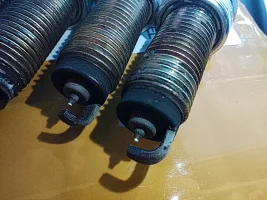
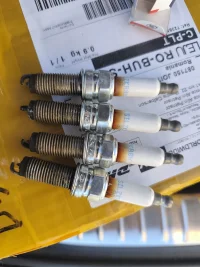
- replaced the spark plugs, the old ones had around 30k km (20k miles) and were black (attached photo)
- I did a smoke test for the intake, no leaks detected.
- The fuel rail pressure stays around 20000 kpa (2900 psi).
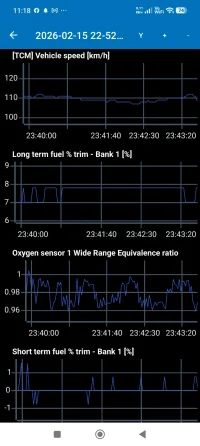
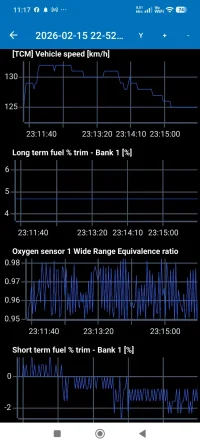
- The O2 sensor reports fluctuations between 0.95 and 0.98, where 1 is stoichiometric A/F ratio and 2 is 100% oxygen and 0% fuel, so it reports just a bit rich mixture, too small I think to count. Also the other Stinger that I drove had the same values and not the consumption issue.
- LTFT stayed at 4.5% and STFT stayed around -1% to 1%
- intake manifold absolute pressure was at 97-100kpa
- timing advance between 15 and 18 degrees
- cat 1 temp 780°C and cat 2 temp 680°C
- engine coolant stays around 100°C, engine oil is around the same temperature
It drives me crazy cause I use it as a daily and burns through my pocked with that fuel usage (20-25% more than it should). In mixed driving I get around 15l/100km (15MPG) without any hard accelerations.
I am planning to do the following hoping I might find the issue:
- replace the fuel pressure sensor (a few times I got the P0191 error and was showing fuel rail pressure at 500-600 kpa, so 10-40 times lower than normal, goes away after turning the engine off and on again)
- try to see if the dealership can override the current ECU fuel map with the stock one, to make sure the previous owner did not try to tune it or anything
- replace the upstream O2 sensor
- take down the GPF and have it checked physically at a specialized service to make sure it is not clogged
- replace the MAP sensor
- replace the HPFP
If anyone can help me in this matter would be great!
I have a 2019 GT-line 2.0 RWD Stinger, 71k miles (115k km) that has all of the GT2 (3.3l) options except for the brembo brakes (yes, I have the adaptive suspension as well, it's a German version of the car with all of the options).
I see very high fuel usage during my daily commute and I did some tests at night on the highway, both in summer and winter. Premium tires for summer and winter, at the recommended pressure, no luggage / people in the car, warm engine and transmission:
- 110 km/h = 8.0l/100km // 69MPH = 29MPG (8th gear at 1850-1900 rpm)
- 130 km/h = 10l/100km // 82MPH = 24MPG (8th gear at 2150-2200 rpm)
This happens on ECO, Comfort and Sport mode.
This is tested exclusively on a straight highway road and it doesn't take into consideration the accelerations to get up to speed when entering the highway, it's strictly constant accelerator pedal and speed.
From what I could find on the forums, even the 3.3 Stinger gets better fuel economy when cruising like this. So something must be wrong with mine. I've drove another Stinger exactly like mine and that one had better fuel economy, on the same road I did the tests (29-30MPG at 85MPH // 8l/100km at 135km/h). Both cars have the same ECU and TCU software version, the one after the GPF issue was fixed in the software, so it cannot be that popular GPF logic bug that was happening on early softwares.
- replaced the spark plugs, the old ones had around 30k km (20k miles) and were black (attached photo)
- I did a smoke test for the intake, no leaks detected.
- The fuel rail pressure stays around 20000 kpa (2900 psi).
- The O2 sensor reports fluctuations between 0.95 and 0.98, where 1 is stoichiometric A/F ratio and 2 is 100% oxygen and 0% fuel, so it reports just a bit rich mixture, too small I think to count. Also the other Stinger that I drove had the same values and not the consumption issue.
- LTFT stayed at 4.5% and STFT stayed around -1% to 1%
- intake manifold absolute pressure was at 97-100kpa
- timing advance between 15 and 18 degrees
- cat 1 temp 780°C and cat 2 temp 680°C
- engine coolant stays around 100°C, engine oil is around the same temperature
It drives me crazy cause I use it as a daily and burns through my pocked with that fuel usage (20-25% more than it should). In mixed driving I get around 15l/100km (15MPG) without any hard accelerations.
I am planning to do the following hoping I might find the issue:
- replace the fuel pressure sensor (a few times I got the P0191 error and was showing fuel rail pressure at 500-600 kpa, so 10-40 times lower than normal, goes away after turning the engine off and on again)
- try to see if the dealership can override the current ECU fuel map with the stock one, to make sure the previous owner did not try to tune it or anything
- replace the upstream O2 sensor
- take down the GPF and have it checked physically at a specialized service to make sure it is not clogged
- replace the MAP sensor
- replace the HPFP
If anyone can help me in this matter would be great!
Attachments
Last edited: